Thinking about getting stronger without cluttering your living room with heavy iron weights? You are not alone. In 2026, home fitness is all about working smarter without spending a fortune or taking up half your bedroom. That is where resistance bands come into play.
Why Resistance Bands Are Your New Best Friend
For a long time, people thought elastic bands were only good for warm-ups or physical therapy. Research has flipped that idea completely. A meta-analysis published in BMC Sports Science found that elastic resistance training builds muscle and strength just as well as traditional free weights and gym machines.¹ Think about that for a second. You can pack an entire functional gym into a single drawer or travel bag.
How does a piece of rubber match up against solid iron? It comes down to basic physics and muscle activation. Your muscles do not have eyes. They cannot tell whether you are lifting a heavy dumbbell or stretching a thick elastic band. They only react to tension.
Bands offer a distinct joint-friendly advantage over heavy weights. Free weights rely on gravity, which creates maximum pull right where your joints are often in their most vulnerable, stretched positions. Bands work differently by building tension as you extend the movement. That means peak strain happens when your muscles are fully contracted, reducing harsh stress on your knees, shoulders, and elbows.
Needed Gear: Choosing the Right Resistance
Before jumping into your first workout, you need the right tools. Walk into any sporting goods store or browse online, and you will see a wide variety of band types. Choosing the right setup keeps your workouts effective and safe.
Here is a quick look at the main styles you will encounter
• Tube Bands with Handles: These feature thick rubber tubing with clipped handles on each end. They are great for movements that mimic cable machines, such as chest presses and shoulder presses.
• Flat Loop Bands: These continuous rubber loops look like giant rubber bands. They are versatile for compound movements like squats, rows, and push-up assistance.
• Mini Loop Bands: Shorter flat loops meant to wrap around your ankles or thighs. They work well for glute bridges, lateral walks, and lower body warm-ups.
Color coding usually signals tension levels, though ratings vary by brand. Yellow and red generally mean lighter tension, while green, blue, and black indicate medium to heavy tension. When picking your first starter set, look for a package that offers a range from 10 to 50 pounds of resistance. That way, you can start light on smaller shoulder movements and move to heavier bands for leg work.
Foundational Resistance Band Exercises for Beginners
Ready to get moving? Mastering a few core movements gives you a complete workout routine. Focus on controlled execution. Keeping your movement steady stops the band from snapping back unexpectedly.
Here is how to perform the foundational movements
1. Banded Goblet Squats: Stand on the inside of a flat loop band with your feet shoulder-width apart. Hold the top of the loop at upper chest level. Keep your chest lifted, bend your knees, and lower your hips. Drive up through your heels to return to standing.
2. Banded Bent-Over Rows: Stand in the middle of your band with feet hip-width apart. Hinge forward at your hips while keeping your back flat. Grab the band handles or edges, pulling your elbows straight back toward your hips. Pause at the top, then lower slowly.
3. Banded Chest Press: Wrap the band around your upper back, looping it right under your armpits. Hold the ends securely in each hand. Stand tall and push straight forward until your arms fully extend. Slowly return your hands to your chest.
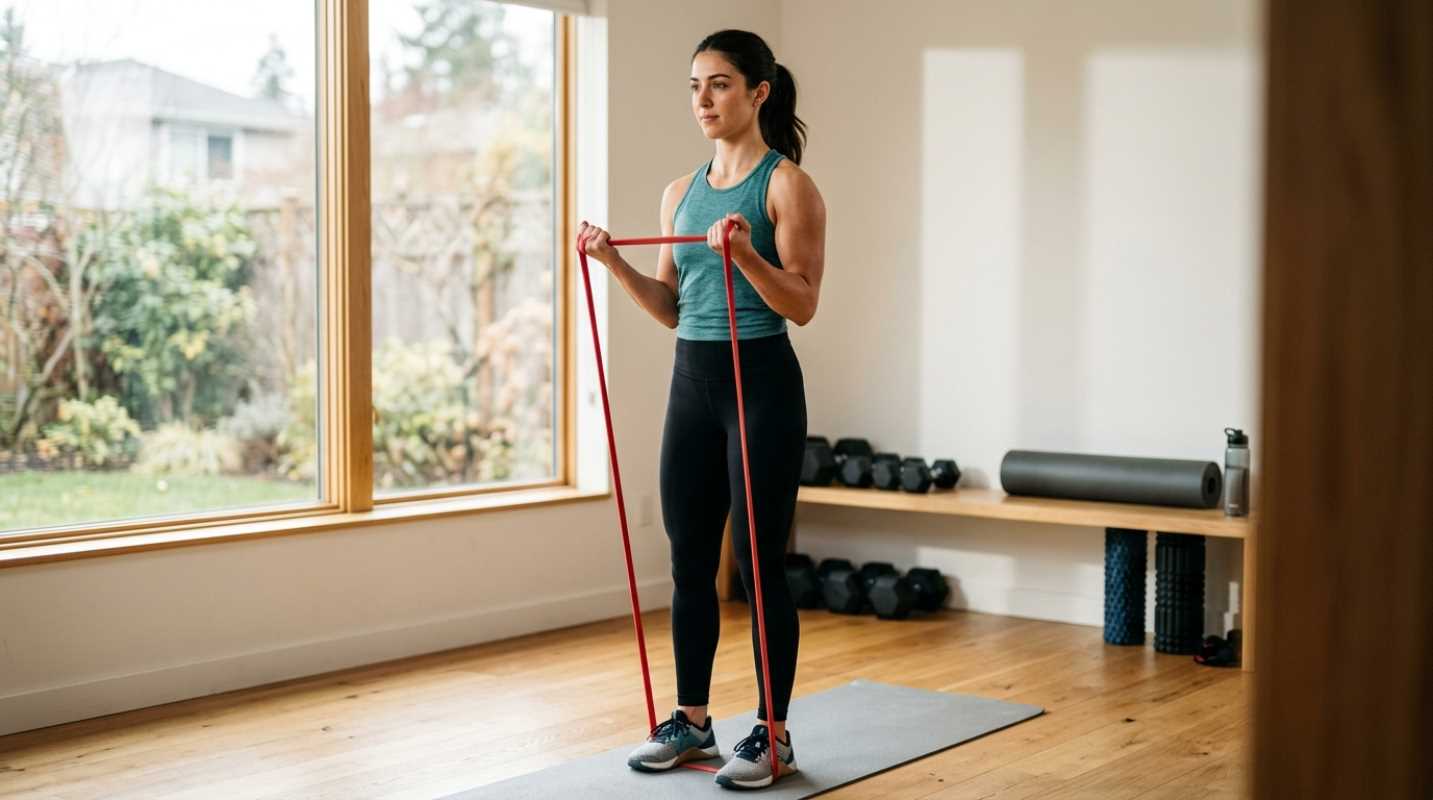
4. Banded Overhead Press: Stand on the center of your band. Bring your hands up to shoulder height with palms facing forward. Press straight overhead until your arms extend, then lower back to shoulder level.
Safety should always come first. Inspect your bands for small tears or white stress marks before every set. If you use a door anchor, make sure the door latches securely and shuts away from you so it cannot pop open during a set.
Building a Home Band Workout Routine
To build muscle effectively, you do not need to spend hours training every single day. A balanced full-body routine performed three days per week (like Monday, Wednesday, and Friday) allows your muscles plenty of time to recover and grow. Research shows that training muscle groups two to three times per week results in the most strength gains.²
For bands, target 10 to 20 repetitions per set. Why higher reps? Because bands exert lighter tension at the start of a movement, higher rep ranges make sure your muscles work close to full effort by the end of the set.³ Keep rest periods around 60 to 90 seconds between exercises.
To keep building strength over time, you need to apply progressive overload. That simply means making the exercise slightly harder as your body adapts. With dumbbells, you just pick up a heavier weight. With bands, you can use these methods
• Increase Repetitions: Build up from 10 reps per set to 20 reps before switching to a heavier band.
• Widen Your Stance: Stepping wider on the band shortens the active length, moving harder immediately.
• Control the Speed: Take three full seconds to lower the band back down, and hold the pause at peak tension for one second.
• Step Up Tension: Transition to a thicker band once your target rep range feels too easy.
Common Mistakes and How to Avoid Them
Starting a band routine brings fast results, but a few simple mistakes can slow your progress.
The most common issue for beginners is letting the band snap back during the return phase of a movement. Letting the band snap back robs your muscles of valuable work time. Always resist the band on the way back down. Your lowering phase should be just as controlled as your lifting phase.
Another mistake is leaving slack in the band at the start of an exercise. If the band hangs loose when you begin a rep, you miss out on tension at the bottom of the movement. Adjust your stance or shorten your grip so the band stays taut right from the start.
Finally, write down your workouts. Keep track of the reps you complete and the band color you used. Staying consistent and beating your past numbers is the absolute secret to building lasting strength at home.
Sources:
1. BMC Sports Science, Medicine and Rehabilitation
https://pmc.ncbi.nlm.nih.gov/articles/PMC6383082/
2. National Center for Biotechnology Information
https://pubmed.ncbi.nlm.nih.gov/33433148/
3. Garage Gym Reviews
https://www.garagegymreviews.com/resistance-band-exercises
*This article on seisim is for informational and educational purposes only. Readers are encouraged to consult qualified professionals and verify details with official sources before making decisions. This content does not constitute professional advice.*


 .jpeg)