Have you ever set a strict two-hour screen time limit, only to watch it collapse into an exhausting argument by late afternoon? You are definitely not alone. Around 60% of parents admit feeling guilty about their children's digital habits, and for good reason. A survey by Lurie Children's Hospital revealed that while parents consider nine hours a week ideal for kids under 13, children actually average roughly 21 hours weekly on screens.¹ That massive gap between our goals and reality creates daily friction in millions of homes.
The core problem is that total bans and dynamic hourly caps rarely work in the real world. Screens are no longer just devices for mindless distraction. They are tools kids use to complete homework, build digital worlds, learn coding, and stay connected with friends. Treating a tablet like a hazard only makes it more enticing.
There is another reality we have to face: our own digital behavior. If you check your phone at red lights or scroll through feeds during family time, your children notice. Around 71% of parents acknowledge using screens to keep children quiet in public. When tech becomes our primary tool for managing behavior or downtime, we cannot be surprised when kids adopt the exact same mindset.
Frameworks Over Fights and Age-Based Guidelines
Instead of tracking every single minute on a timer, major health organizations like the American Academy of Pediatrics and the World Health Organization recommend looking at context, content quality, and developmental stage.²
Here is how to apply age-based guidelines without constantly fighting with your children
• Babies under 18 months: Limit screen exposure strictly to live video calls with family members.
• Toddlers aged 18 to 24 months: Introduce high-quality educational programming, and make sure you watch alongside them to explain what they are seeing.
• Preschoolers aged 2 to 5 years: Cap non-educational screens at one hour daily, keeping content interactive and co-viewed.
• Kids aged 6 and older: Focus on balanced screen use where media habits do not displace sleep, exercise, or real-life friendships.
It also pays to distinguish between passive consumption and active creation. A teenager spending two hours editing video projects or learning digital illustration is engaging in a very different activity than one scrolling through social media feeds for hours. When setting limits, focus your energy on curbing passive scrolling while leaving room for creative expression.
The Art of Enforcing Tech Rules Consistently
Enforcement is usually where household policies fail. You set a rule, your child gets upset, and after 20 minutes of complaining, you give in just to keep the peace. Nearly 28% of parents admit to giving in to screen demands multiple times a week to avoid meltdowns.
To build a routine that holds up over time, rely on structure rather than daily negotiations
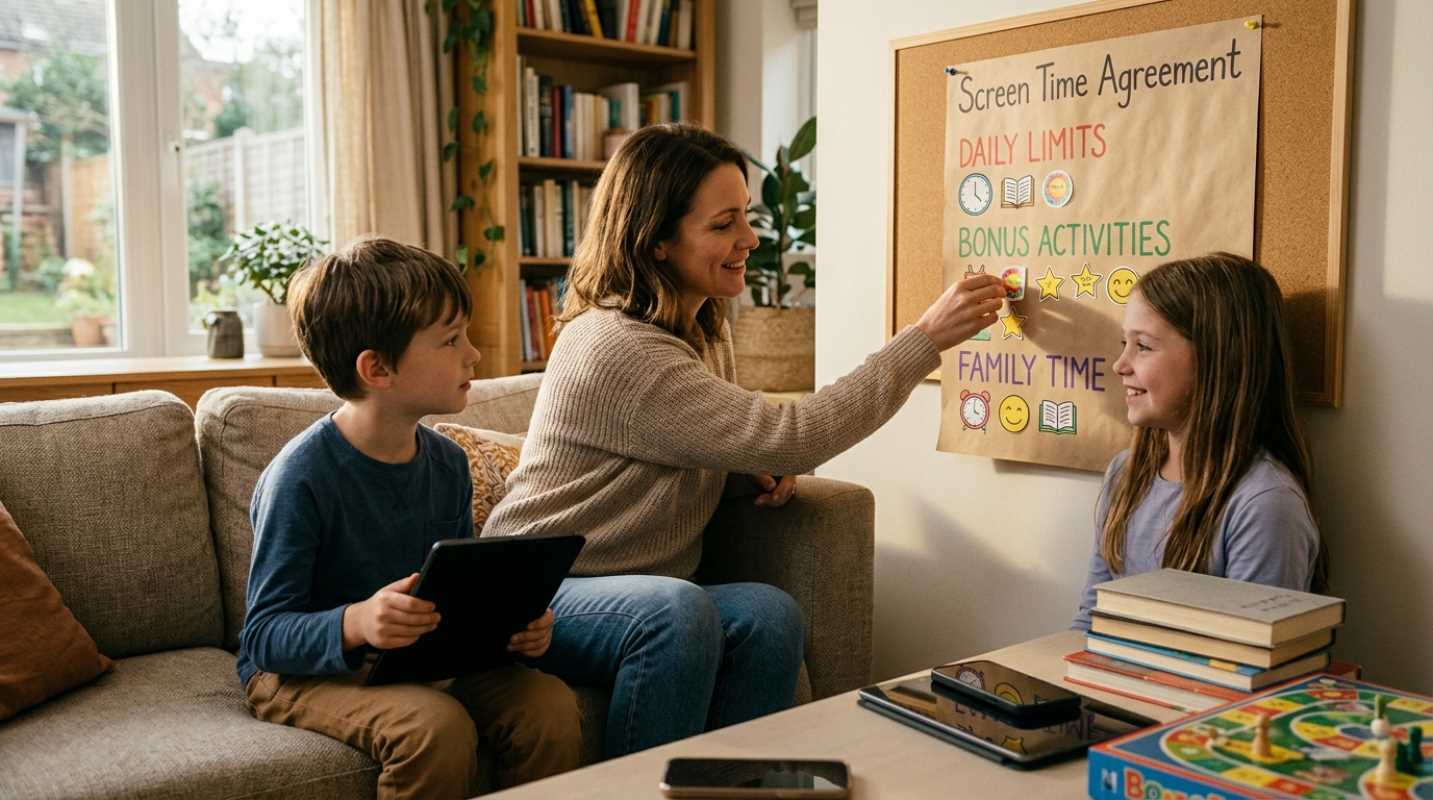
1. Co-create a family media plan: Sit down with your kids during a quiet moment to draft a shared contract. Ask them what rules they consider fair. When children participate in making the rules, they feel ownership and follow them far more willingly.
2. Use tech guardrails: Let automated screen time controls handle the firm shut-off. When an app locks down at bedtime, the device becomes the enforcing agent, taking you out of the role of bad guy.
3. State consequences neutrally: When screen time ends, communicate facts without judging or criticizing. Avoid saying things like "You are addicted to that game." Instead, say: "It is 5:00 PM, and our agreement was to turn off the console now."
4. Outlast the extinction burst: When you introduce new boundaries, expect pushback to spike temporarily. Child psychologists call this sudden increase in tantrums an extinction burst. Holding firm through the first week or two causes the defiant behavior to drop sharply.
Balancing Screens With Other Activities
The easiest way to reduce unnecessary device use is to protect needed offline routines first. Frame screen access as a privilege earned after non-negotiable daily habits are completed.
Establish non-negotiable anchor times and spaces in your home
• Device-free bedrooms: Require all mobile devices to charge in a central family area overnight. This simple boundary protects sleep quality, prevents late-night texting, and reduces bedtime anxiety.
• Screen-free mealtimes: Keep devices away from the dinner table to preserve face-to-face family conversations.
Make sure daily priorities happen first. Completing homework, finishing household chores, and getting at least 60 minutes of physical activity should happen before screens turn on.
When screens do turn off, expect your kids to complain about being bored. Try to view that boredom as a good thing. Downtime forces children to rely on their imagination, read books, or invent physical games. Keep low-tech options like art supplies, board games, and sports gear visible and accessible so they have quick choices.
Building Digital Resilience for the Long Term
Our ultimate goal is not to police our children's devices until they turn eighteen. It is to help them build internal self-regulation so they can manage technology independently when they grow up. Surgeon General advisories emphasize that engagement algorithms are deliberately designed to keep young users hooked on continuous scrolling.³ Teaching kids to notice how screen use impacts their mood is needed for long-term health.
Maintain open, ongoing conversations about what your kids watch and play. Ask reflective questions that encourage self-awareness: "How do you feel after spending two hours on that app?" or "Do you notice feeling tired or irritable when you play that game for a long time?"
When kids connect their digital habits with their physical and emotional well-being, they begin making better choices on their own. You move away from constant rule enforcement and toward guiding them to live comfortably in a connected world.
Sources:
1. Lurie Children's Hospital
https://www.luriechildrens.org/en/blog/screen-time-2025/
2. Common Sense Media
https://www.bespacific.com/2025-the-common-sense-census-media-use-by-kids-zero-to-eight/
3. Screen Time Guidelines for Children
https://commonwealthpeds.com/screen-time-guidelines-for-children/
*This article on seisim is for informational and educational purposes only. Readers are encouraged to consult qualified professionals and verify details with official sources before making decisions. This content does not constitute professional advice.*


 .jpeg)