Have you noticed more blue-black panels popping up on neighborhood roofs lately? You're not alone. Homeowners everywhere are rushing to go solar, driven by climbing utility bills and a desire for energy independence. There's something undeniably satisfying about generating your own electricity right above your living room and watching your monthly bill plummet.
Before you jump on the phone and sign a contract with the first sales representative who knocks on your door, you need to take a step back. Going solar is a major home upgrade, comparable to remodeling a kitchen or replacing an HVAC unit. Understanding how the technology fits your specific home will save you thousands of dollars and plenty of headaches down the road.
Evaluating Solar for Your House
Not every roof is an ideal candidate for solar power. Before you start picking out hardware, you have to look it up.
First, check your roof's physical condition and layout. If your roof is over 15 years old, you should replace it before installing solar panels. Removing an entire solar array to fix a leaky roof later can easily cost you $2,000 to $4,000 in labor alone.
• Orientation: South-facing roofs receive the most direct sunlight throughout the day in North America, getting the most from power output. West-facing roofs are a strong second choice because they capture late-afternoon sun when electricity demand peaks.
• Shading: Trees, chimneys, and neighboring structures create shadows that drag down your system's output. Even partial shade on a single panel can reduce the performance of an entire string if you don't have microinverters installed.
• Local Climate: Your home's exposure to peak sunlight hours determines how many panels you actually need. A sunny home in Arizona will generate far more kilowatt-hours per panel than a home in cloudy Seattle.
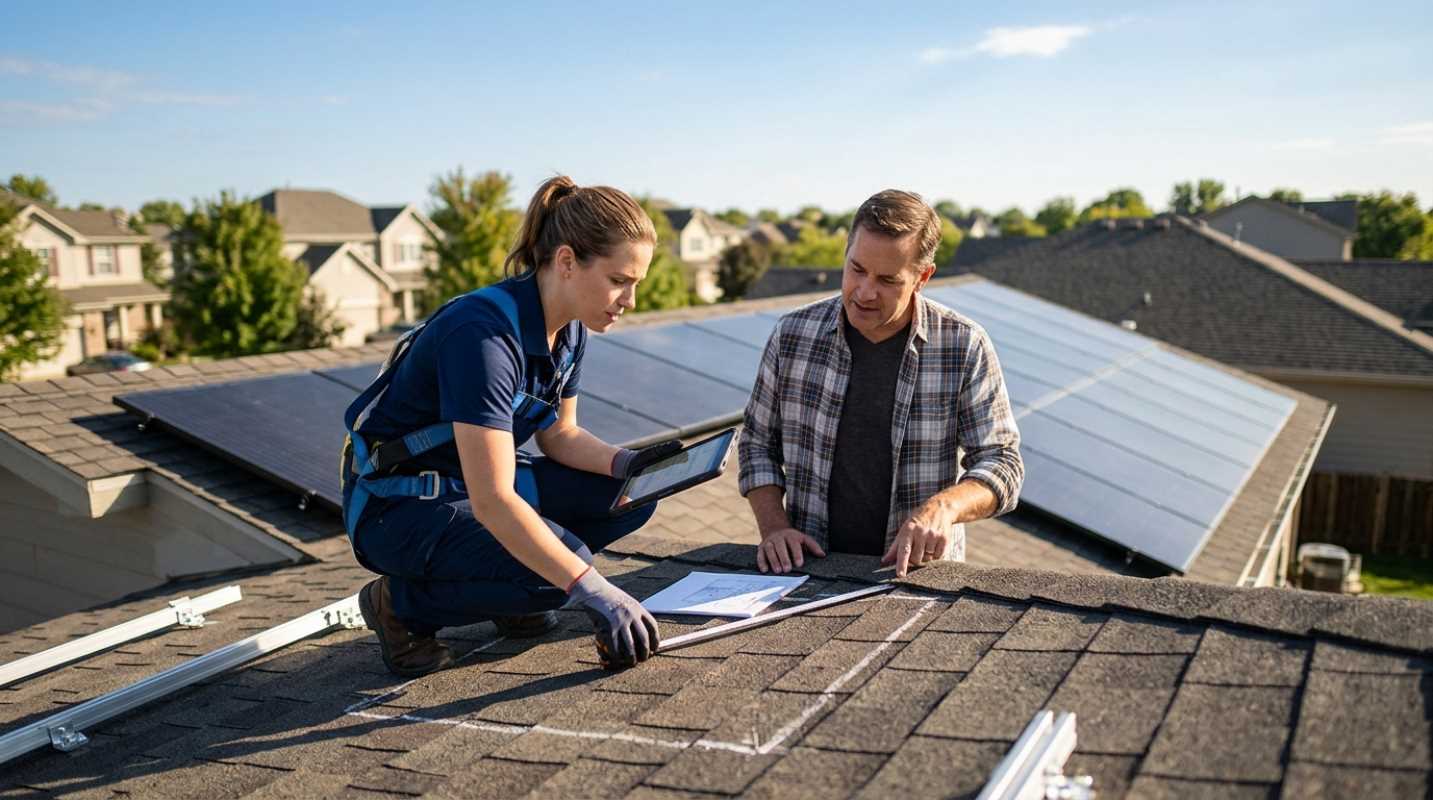
This is why a professional site assessment matters so much. An installer uses specialized software to map sun exposure, inspect your electrical panel, and verify that your roof rafters can handle the added weight.
Breaking Down Solar Panel Cost and Payback Period
Let's talk numbers, because the financial side of solar is usually what makes or breaks the decision.
On average, residential solar systems cost around $2.50 to $3.30 per watt before any incentives.¹ For a typical single-family home needing an 8 kW system, that translates to a gross price tag between $20,000 and $25,000. Fortunately, you won't pay that full sticker price thanks to federal tax credits.
The federal Residential Clean Energy Credit allows you to claim a 30% tax credit on qualified equipment and installation costs.² That brings the net cost of an 8 kW system down to roughly $14,000 to $17,500. Keep in mind that this is a non-refundable tax credit, meaning you need a federal tax liability to use it, though unused portions carry over to future tax years.
Here is how average systems break down by size and net cost
• 6 kW System: Ideal for smaller homes or light energy users. Gross cost runs $15,000 to $18,000, dropping to $10,500 to $12,600 after the federal credit.
• 8 kW System: Ideal for average single-family homes. Gross cost runs $20,000 to $25,000, dropping to $14,000 to $17,500 after the federal credit.
• 10 kW System: Ideal for larger homes or families with electric vehicles. Gross cost runs $25,000 to $32,000, dropping to $17,500 to $22,400 after the credit.
• 12 kW System: Ideal for very large properties or full home electrification. Gross cost runs $30,000 to $36,000, dropping to $21,000 to $25,200 after the credit.
To figure out your payback period, divide your net system cost by your estimated Year 1 utility bill savings. Across the country, the average solar payback period lies between 6 and 10 years.³ Once you cross that break-even mark, the system generates practically free power for the rest of its 25 to 30-year lifespan.
Your exact return on investment depends heavily on your local utility rates and net metering rules. If your utility company charges high rates, your system pays for itself much faster. But in areas transitioning away from traditional 1-to-1 net metering credits, adding a home battery system is becoming necessary to hold onto your long-term savings.
Understanding the Home Solar Installation Process
Once you choose an installer and sign a contract, the actual process unfolds in predictable stages. Think of it like a relay race where permitting takes up most of the time, and actual construction is the final sprint.
1. Initial Site Assessment: A technician measures your roof, checks your structural framing, and evaluates your main electrical panel to see if it needs a service upgrade.
2. Design and Permitting: Engineers draft your system blueprint, and the installer submits permits to your local city building department and electric utility company. This stage often takes 3 to 6 weeks.
3. Installation Day: A crew arrives to attach mounting racking, lay electrical conduit, set up inverters, and secure the panels. The physical installation usually takes just 1 to 2 days.
4. Inspection and Interconnection: A local building inspector checks the work, and your utility grants Permission to operate (PTO).
Selecting a reputable installer is far more important than obsessing over individual panel brands. Physical panels only account for roughly 15 percent of the total project cost. The quality of the installation, wiring, and local service warranties matters far more over two decades of operation.
Maintenance and Long-Term Performance
A common myth is that solar panels demand endless upkeep. In reality, modern solar arrays have no moving parts, making them remarkably low-maintenance.
Rain handles most dirt and dust cleanup automatically. If you live in a dry region or go months without rain, a quick rinse with a garden hose is usually all you need. You shouldn't ever scrape panels or use harsh chemical cleaners.
Most reputable panel manufacturers offer 25-year performance warranties that guarantee the panels will still produce at least 80 to 85 percent of their original output after a quarter century. Inverters typically carry 10 to 25-year warranties, depending on whether you choose string inverters or microinverters.
To track your production, modern systems connect directly to intuitive mobile phone apps. You can monitor daily electricity generation in real time, watch your production curves, and spot performance drops long before they affect your utility bill.
Making the Switch with Confidence
Switching your home to solar power delivers both immediate utility bill relief and strong long-term property protection. You are effectively locking in your electricity costs and protecting your household against inevitable power rate hikes from local utilities.
Before taking the plunge, reach out to at least three certified local installers for detailed quotes. Compare their proposed system designs, equipment warranties, and customer reviews rather than looking solely at the bottom-line price tag.
Taking time to evaluate your roof, run the financial math, and choose the right installer sets your home up for decades of clean power and predictable savings.
Sources:
1. Solar Permit Solutions - Solar Panel Payback Guide
https://www.solarpermitsolutions.com/blog/understanding-solar-panel-payback-period-complete-guide-for-2025
2. ENERGY STAR - Federal Tax Credits for Solar Energy
https://www.energystar.gov/about/federal-tax-credits
3. CPTL Energy - Solar Power Installation Cost Guide
https://www.cptlenergy.com/post/solar-power-installation-cost-guide-2025
*This article on seisim is for informational and educational purposes only. Readers are encouraged to consult qualified professionals and verify details with official sources before making decisions. This content does not constitute professional advice.*